Last updated: November 15, 2026
Quick Answer: In a direct three-season room material comparison across durability, upkeep, and cost, aluminum leads for structural strength, while multi-chamber vinyl wins on thermal performance and corrosion resistance. Aluminum framing provides a yield strength of 21,000 pounds per square inch, making it the top choice for wide spans and high-wind zones. However, vinyl framing eliminates condensation and salt rot entirely. If you want natural timber, kiln-dried cedar supports roof loads topping 50 pounds per square foot, though it requires routine sealing every two to three years.
Key Takeaways
- Aluminum framing holds tight against 30 mph winds, delivering rigid support with slim posts.
- Salt spray wipes clean off vinyl frames without causing blisters, rust, or peeling paint.
- Real cedar beams bring authentic cabin character, natural fragrance, and solid structural integrity.
Choosing structural framing for an enclosed porch often leaves property owners balancing rot resistance against structural rigidity. In any objective three-season room material comparison, extruded aluminum framing ranks among the most versatile materials for most installations, balancing weather tolerance, low upkeep, and slender sightlines. The breakdown below details how aluminum, vinyl, natural timber, and composite components perform over decades of seasonal exposure.
Disclosure: threeseasonroomguide.com earns compensation through affiliate partnerships when purchases are made via links on this site, at no added cost to you.
Our Top 3 Picks at a Glance
- #1 Best Overall: Extruded Aluminum Framing — Unmatched structural strength-to-weight ratio, narrow sightlines, and factory-applied powder coatings that resist peeling.
- #2 Best Budget Pick: Multi-Chamber Vinyl Framing — Zero corrosion risk, natural thermal dampening, and completely impervious to rot or fungal decay.
- #3 Best Heavy-Duty / Upgrade Pick: Kiln-Dried Douglas Fir or Cedar Wood Framing — Superior load-bearing capability, warm traditional interior aesthetic, and infinite stain or paint flexibility.
| Product / Option | Best For | Core Spec | Standout Feature | Action |
|---|---|---|---|---|
| Extruded Aluminum | High-wind areas & wide spans | 6063-T6 alloy, 0.062-inch wall thickness | Slender frames with maximum glass area | Check current price at Home Depot or specialized patio dealers |
| Multi-Chamber Vinyl | Coastal humidity & low budgets | Virgin PVC, 0.080-inch multi-cavity walls | Solid color throughout that never chips | Check current price at Lowe’s or regional window suppliers |
| Kiln-Dried Structural Wood | Architectural matches to classic homes | 19% maximum moisture content (MC19) | High structural spans and authentic grain | Check current price at 84 Lumber or local lumber yards |
| Capped Composite Trim | Exterior cladding and splash zones | Polyethylene-wood core with polymer cap | Resists ground-level moisture and insects | Check current price at Menards or building supply outlets |
Before ordering framing parts, review our three-season room planning guide to check your local setback rules. This evaluation supports the broader pillar covering buying and evaluating three-season room solutions by examining physical performance traits before structural plans are drawn.
Which Framing Material Is Best for a Three-Season Room?
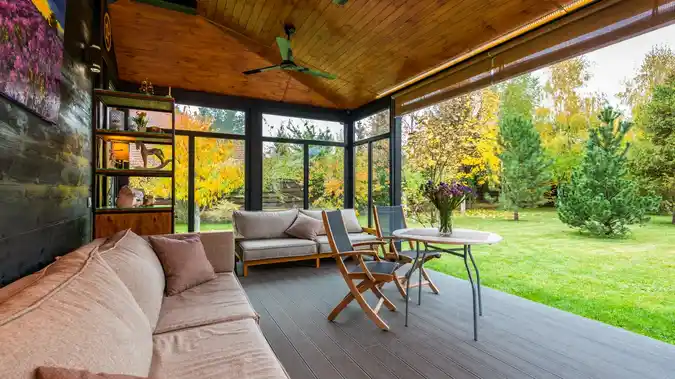
Picture this: you’re sitting inside on a blustery autumn afternoon watching thirty-mile-per-hour gusts rattle the trees in your backyard. Your perimeter walls stay completely rigid without groaning, because the slender metal frames carry high wind-load ratings without requiring bulky center posts.
Specifically, aluminum serves as the structural core for most three-season spaces. Manufacturers use structural 6063-T6 alloy, which provides yield strengths around 21,000 pounds per square inch. This high tensile strength allows builders to design wall openings spanning six to eight feet wide while keeping frame profiles under two inches wide.
Because of that structural aluminum framing strength, builders can eliminate bulky intermediate studs. However, uninsulated aluminum conducts exterior temperatures directly into the interior. When cold autumn winds hit the outer wall, the interior metal surfaces drop to matching temperatures, creating interior condensation along bottom tracks.
So fasteners also require scrutiny during assembly. When steel screws contact aluminum in coastal air, galvanic corrosion degrades the connection unless installers use 300-series stainless steel fasteners with neoprene isolation washers. Reviewing our patio enclosure hardware guide will help you select corrosion-safe connectors.
- Structural profile depth: 2 inches to 4 inches nominal.
- Wall gauge: 0.050 to 0.080 inches for load-bearing posts.
- Finish standard: Fenestration and Glazing Industry Alliance AAMA 2604 powder coatings that hold color for 10 to 15 years.
- Weight: Approximately 1.1 pounds per linear foot for standard 2×2 corner extrusions.
Overall, standard extrusions deliver high strength per pound. After reviewing these fenestration standards and weight metrics, property owners should also assess their local shade conditions. Skip raw aluminum if you live in deep shaded woods where fallen wet leaves pile against low base rails, creating stubborn water stains on painted finishes.
- Buy this if: You want wide scenic glass spans, slim frames, and zero structural warping over a thirty-year operating life.
- Skip this if: You plan to heat the space during sub-freezing mornings, where uninsulated aluminum causes immediate perimeter sweating.
How Do Aluminum, Vinyl, and Wood Compare for Porch Enclosures?
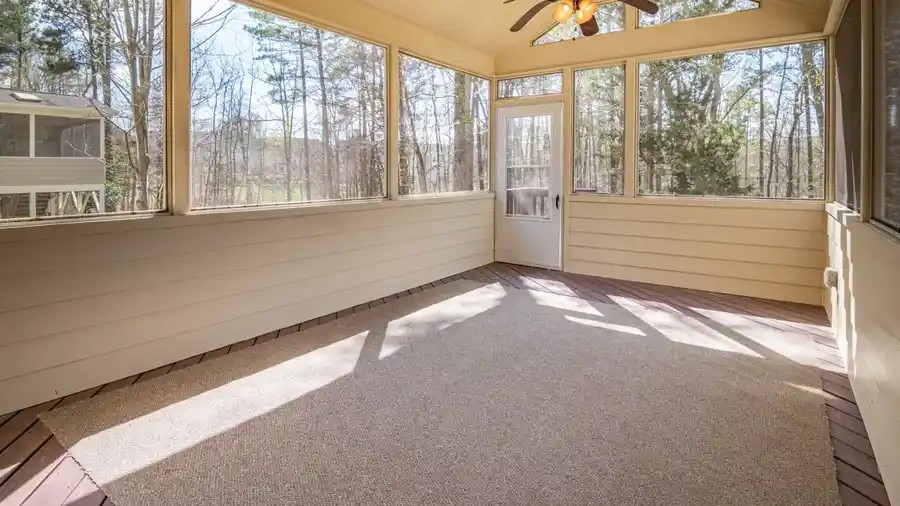
Picture this: you’re walking along the side of your home after a relentless week of humid coastal downpours. Salt spray and wet mist have coated every surface, but your room framing wipes clean with a damp rag without a single blister, rust spot, or peeling paint edge.
In contrast, rigid extruded polyvinyl chloride (PVC) framing eliminates corrosion entirely. Manufacturers build these systems using multi-chamber profiles with outer wall thicknesses averaging 0.070 to 0.090 inches. Those internal air cavities improve rigidity while providing a natural thermal break that slows exterior chill from transferring inside.
However, vinyl framing expands and contracts dramatically with temperature swings. PVC has a thermal expansion coefficient nearly three times higher than aluminum, moving up to 3/16 of an inch over an eight-foot length across seasonal shifts. If wall segments are pinned too tightly during summer installations, the vinyl can bow inward when winter freezes set in.
Likewise, wall thickness affects light transmission. Vinyl profiles are thicker than metal, reducing glass viewing area by roughly 10% to 15%.
- Thermal movement: Up to 0.18 inches per 8-foot run across an 80-degree temperature range.
- Impact resistance: Minimum 1.5 ft-lb/in notch resistance under ASTM D256 guidelines.
- Color stability: Titanium dioxide (TiO2) additives prevent yellowing under intense UV exposure.
- Maintenance: Semi-annual wash with mild detergent; no repaint cycle required.
Therefore, vinyl performs best when low maintenance outweighs slender profile needs. Following these ASTM impact guidelines and thermal movement specs, buyers must weigh framing height limits. Skip vinyl framing if your design features tall cathedral ceilings requiring slender rafters that span more than twelve unsupported feet.
- Buy this if: You live within five miles of an ocean coastline and refuse to repaint framing or monitor joints for white rust.
- Skip this if: You dislike thick frame borders around glass panes or live in an area subject to intense 100-degree seasonal swings that cause vinyl creaks.
Wood Framing: Structural Warmth with Ongoing Upkeep Obligations
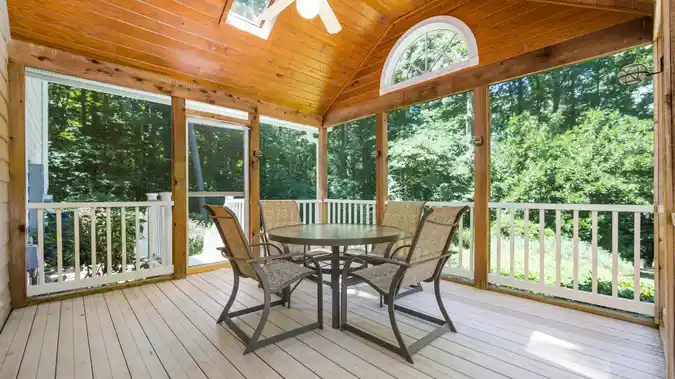
Picture this: you’re enjoying early morning coffee surrounded by exposed Douglas fir ceiling beams that match your home’s historic interior trim. The natural cedar aroma fills the enclosure, creating an earthy cabin atmosphere that no synthetic extrusion can match.
For example, natural timber delivers unmatched traditional beauty and immense point-load strength. Structural posts milled from #1 kiln-dried Douglas fir or Western Red Cedar handle snow loads topping 50 pounds per square foot with minimal deflection. Wood can be trimmed, planed, stained, and painted to mirror existing home architecture with absolute precision.
On the other hand, timber demands ongoing labor to prevent environmental failure. Moisture is an active threat: unsealed wood fibers swell in spring rains and shrink in dry winter air, causing doors to bind in their tracks.
Because of that moisture sensitivity, exterior exposure requires proactive protection. Cedar certified by the Forest Stewardship Council resists dry rot naturally, yet horizontal window sills still require fresh acrylic latex paint or penetrating oil stains every two to three seasons. Pairing your frame with insulated roof panels can help shield internal rafters from condensation runoff.
- Load capacity: Capable of carrying downward snow loads exceeding 50 lbs/sq ft.
- Moisture standard: Kiln-dried to MC19 or lower to prevent framing twist after installation.
- Rot resistance: Cedar and redwood provide natural heartwood extractives that ward off fungal decay.
- Maintenance: Recoating or sealing needed every 24 to 36 months on sun-exposed walls.
Who Should Skip This: Skip solid wood if you want zero annual maintenance or plan to leave the room unmonitored at a seasonal vacation home.
- Buy this if: You need heavy roof support for northern snow loads and prefer traditional architectural craft.
- Skip this if: You want a clean wipe-down finish without scraping, sanding, or staining chores.
Capped Composite Framing and Trim: Moisture-Proof Perimeter Protection
Meanwhile, capped composite components have emerged as an alternative in modern three-season room material comparison discussions. These components combine dense reclaimed wood flour with recycled polyethylene plastic, encased in an impenetrable outer polymer cap.
In particular, composites excel in the vulnerable splash zone where rain bounces off a patio or deck floor onto wall baseplates. Traditional wood rots in this perimeter zone, and bare aluminum can suffer pitting from standing water puddles. A composite baseboard rail never absorbs groundwater, never splits, and never requires stain.
Nevertheless, composite profiles have high thermal flex and low structural stiffness across open spans. As a result, builders use composite boards as exterior cladding and decorative wraps over a structural aluminum or treated wood core, rather than as self-supporting window frames.
- Moisture absorption: Under 0.5% water uptake after continuous submersion.
- Core structure: Wood-plastic composite core capped on three or four sides with high-density polymer.
- Fastening: Hidden clip systems or color-matched composite deck screws with mushroom-reducing threads.
- Maintenance: Occasional scrub with soap and water to clear accumulated surface dust.
Who Should Skip This: Skip composite boards if you are trying to minimize frame thickness, since wrapped framing creates wider, bulkier wall profiles.
- Buy this if: You are building low to the ground and need baseplate materials that resist wet soil and grass splashback.
- Skip this if: You expect the material to form slender, self-standing window mullions on its own.
Three-Season Room Material Comparison: Enclosure Glazing and Wall Panels
Next, consider the transparent wall panels that fill the spaces between your structural frames. Framing supports the room, but the infill panels dictate your daily comfort, seasonal heating gain, and wind protection.
Glass vs. Memory Vinyl Glazing Options
For instance, tempered safety glass delivers optical clarity that never scratches, clouds, or ripples in hot sun. Glass panels block outdoor drafts completely, helping your porch trap solar warmth during crisp spring and autumn days. However, glass panels add substantial weight, requiring heavier aluminum or wood posts that increase structural foundation demands.
Conversely, 10-mil flexible vinyl window panels offer a lightweight, shatterproof alternative. When struck by stray balls or high winds, memory vinyl flexes outward and snaps back to a flat plane within minutes. Flexible vinyl weighs a fraction of glass, allowing builders to use lighter framing and multi-track window stacks that slide open to 75% ventilation. You can inspect layout options in our three-season room cost breakdown to compare budget impacts.
| Glazing Material | Relative Cost | Weight Impact | Optical Clarity | Ventilation Flexibility |
|---|---|---|---|---|
| Single-Pane Tempered Glass | Moderate | Heavy (approx. 2.5 lbs/sq ft) | Flawless, scratch-resistant | Slider vents open to 50% max |
| 10-Mil Memory Vinyl | Low to Moderate | Very light (under 0.2 lbs/sq ft) | Good, but can scuff if wiped dry | 4-track units open to 75% max |
| Double-Pane Low-E Glass | High | Very heavy (approx. 4.5 lbs/sq ft) | Flawless with thermal barrier | Standard sash openings (50%) |
Evaluating Long-Term Ownership and Value
Ultimately, selecting materials for an enclosed porch comes down to balancing structural durability against regular upkeep. When completing a three-season room material comparison for your property, evaluate your local weather demands before locking in your framing dimensions.
Specifically, a coastal cottage facing salt spray benefits from the rust-free properties of multi-chamber vinyl. In contrast, an open suburban patio subject to heavy wind gusts justifies extruded aluminum for its rigid stability and narrow sightlines. If your home has classic architectural details, structural timber beams bring timeless character, provided you schedule regular exterior sealing.
In short, matching the right framing profile to your regional conditions keeps your three-season enclosure functional and attractive through decades of changing weather. By weighing structural load ratings, thermal movement, and maintenance needs early, you ensure your outdoor living space stays dependable year after year.
Drafted with AI; not yet reviewed by a person.








4 thoughts on “Three-Season Room Material Comparison”