Last updated: November 15, 2026
Quick answer: if you want the room to stay useful for all 12 months, choose a four-season room; if you only need it for about 7 months of the year, a three-season room is usually the simpler choice. A three-season room is the better pick if the space will be used mostly in spring, summer, and fall; a four-season room is the better pick if the room needs to stay useful through winter and be tied into HVAC. The real decision is not style. It is insulation, heating and cooling, permit complexity, and how much of the year the room must feel like part of the house.
Key takeaways
- A three-season room is built for fair-weather use and usually gives up winter comfort to keep the project simpler.
- A four-season room is built to behave more like interior living space, so it needs stronger insulation and HVAC planning.
- The biggest cost difference usually comes from the shell, the mechanical work, and the permit path, not from the furniture.
- Pick the room type that matches your climate and how often you want to sit there with the windows closed.
- If winter use matters, choose the four-season path; if seasonal use is enough, the three-season room avoids overbuilding.
What is the real difference?
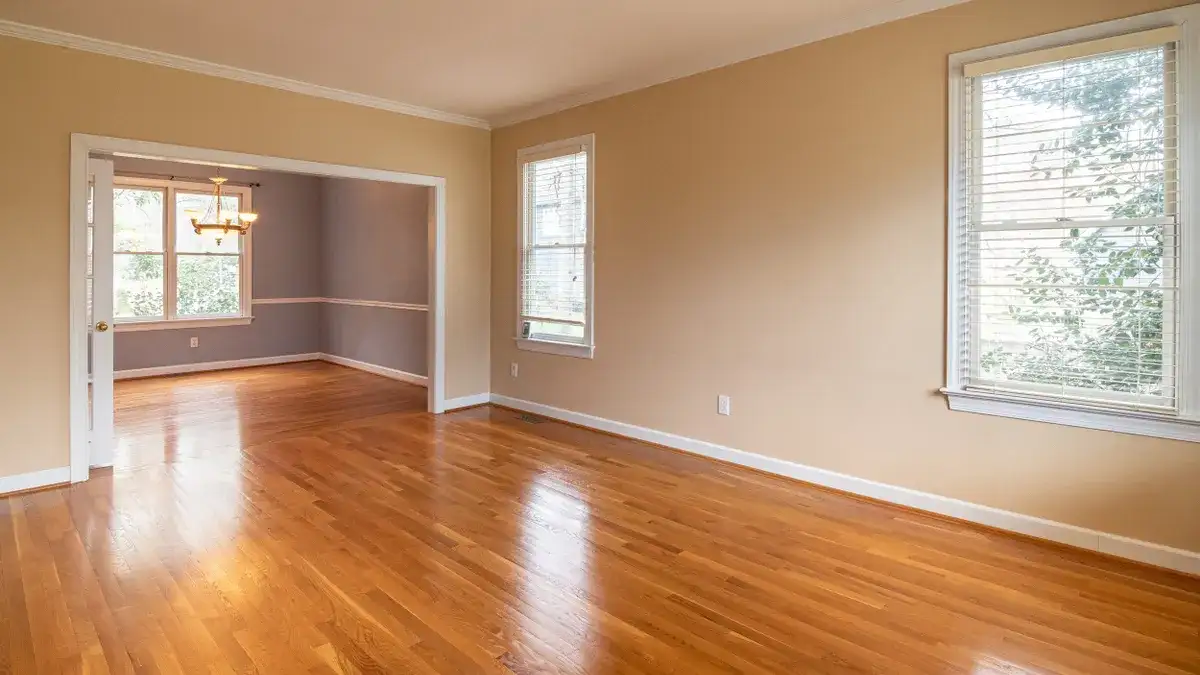
A three-season room is a lighter shell for mild-weather use, while a four-season room is designed to work like part of the house all year. That difference shows up in insulation, windows, air sealing, and whether the room can comfortably connect to HVAC.
A three-season room usually accepts more temperature swing. It is the right fit when the goal is extra sitting space, a breakfast nook, or a bug-free room that does not need to stay warm in January. A four-season room, by contrast, is built for year-round comfort and is the safer choice if the room will serve as a daily family space.
The cleanest shorthand is this: three-season rooms are for extending the usable months of the house, while four-season rooms are for extending the house itself. That distinction affects the permit path too, because a room meant to function as conditioned living space often faces more code scrutiny than a seasonal enclosure. For a project that may be reclassified as conditioned space, check local rules and consult a licensed contractor or building department before you build, because permit treatment can vary by jurisdiction and scope. See the DOE’s guidance on air sealing and insulation, and review your local building department’s requirements.
Three-season room: who should choose it?
A three-season room wins for the homeowner who wants more usable space without committing to full-time conditioning. It is the better choice when the room will be open for much of the year and closed off when the weather turns harsh.
This option makes sense when the site has a mild climate, or when the room will be used for short stretches rather than long winter stays. If the main goal is morning coffee, evening reading, or a place to keep plants and guests out of the rain, the 3-season format does the job with less complexity.
Its biggest strength is restraint. A three-season room can avoid the expense and design burden of full HVAC integration, heavy insulation, and the kind of permit review that comes with adding more conditioned square footage. That can keep the project simpler from the start.
The downside is just as clear: when temperatures drop hard or climb fast, comfort drops with them. A three-season room is not the right answer if the plan is to use the space as a true living room in January or July. It is also the weaker choice if the room must feel like a natural extension of the kitchen or family room every day of the year.
Pros and cons of a three-season room
Pros
- Easier fit for seasonal use
- Less demand for full HVAC tie-in
- Often simpler to permit than a conditioned room
- Good for spring, summer, and fall use
Cons
- Poor winter comfort in colder climates
- Less useful as a true daily living space
- Limited upgrade path if future year-round use becomes important
A three-season room is for the buyer who values flexibility and a lighter project over full comfort in every month. It is not for someone who already knows the room must behave like an interior room by next winter.
Four-season room: when does it win?

A four-season room wins when the space needs to be comfortable in every month and when the room is expected to function like the rest of the house. That is the right call if winter use matters, if the room is attached to the main living area, or if the owner wants the cleanest bridge between indoors and outdoors.
The appeal is straightforward: stronger insulation, better temperature control, and a layout that can work with HVAC instead of fighting it. A four-season room is the safer choice for a family room, a dining space, or a home office that cannot go dormant for part of the year.
This option is also the more defensible one in a cold climate. A seasonal room that feels fine in October can become a dead zone by January. A four-season room avoids that problem because it is planned from the start as conditioned space, not as a fair-weather add-on.
The trade-off is cost and project weight. More insulation, more mechanical planning, and more permit attention usually mean more work. A four-season room is also the wrong move if the room will only be used a few months a year, because the extra build quality may sit unused for long stretches.
Pros and cons of a four-season room
Pros
- Usable in every season
- Better fit for HVAC and year-round comfort
- Stronger choice for daily living space
- More likely to feel like part of the home
Cons
- More complex build
- Usually a heavier permit path
- Not worth it for occasional use only
- Easier to overbuild if the climate is mild
A four-season room is for the owner who wants a real extension of the house, not just a seasonal retreat. It is not for someone who only needs a screened or lightly enclosed space for part of the year.
The honest side-by-side
The 3-season option is the winner on simplicity, while the 4-season option wins on comfort and long-term usefulness. The table below shows where the choice changes in real life.
| Criteria | Three-season room | Four-season room | Winner for this condition |
|---|---|---|---|
| Insulation level | Lighter insulation package | Built for stronger insulation and tighter thermal control | Four-season room for winter comfort |
| HVAC compatibility | May not be tied into HVAC | Designed to work with HVAC | Four-season room for year-round use |
| Seasonal comfort | Best in spring, summer, and fall | Comfortable across 4 seasons | Three-season room for fair-weather use |
| Permit implications | Often simpler, depending on local rules | More likely to trigger full review as conditioned space | Three-season room for lighter paperwork |
| Project complexity | Lower overall complexity | More coordination with mechanical work | Three-season room for a simpler job |
| Energy use | Less pressure to condition the room year-round | Built to be conditioned space | Three-season room for occasional use |
| Use as daily living space | Limited by temperature swings | Works as a true living area | Four-season room for daily use |
| Upgrade path | Can be a good first step, but may need reinvestment later | Better if year-round use is already the goal | Four-season room for long-term planning |
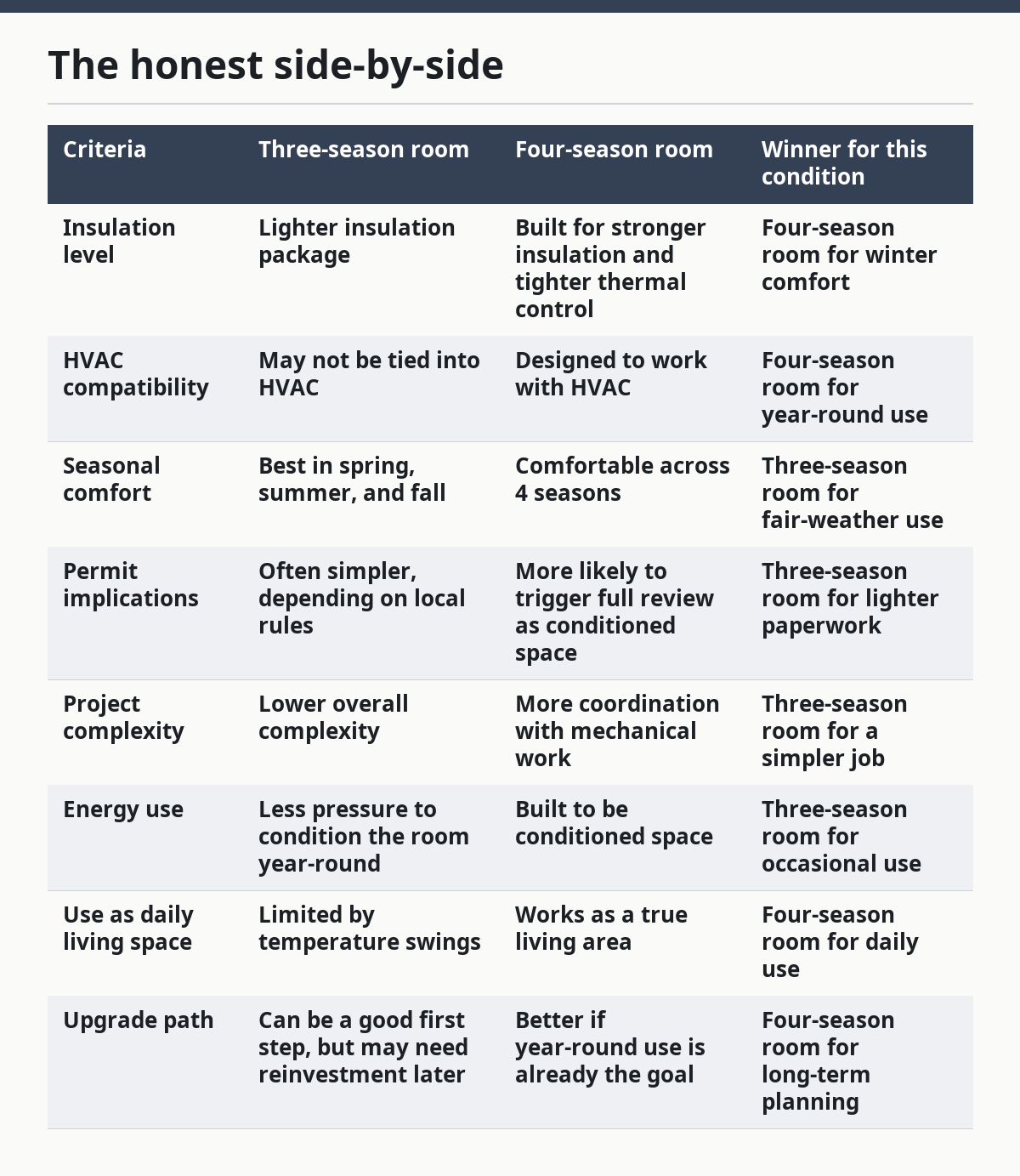
The key point in the table is this: if the room must feel comfortable without opening and closing the calendar, the 4-season choice wins. If the room only needs to extend the pleasant months, the 3-season choice saves trouble.
How does insulation change the decision?
Insulation is the divider that makes a three-season room different from a four-season room in practical use, not just in name. A better-insulated room holds temperature better, cuts drafts, and gives HVAC a fighting chance.
For a three-season room, insulation is usually enough to take the edge off weather, not to stabilize the room all year. That is why these rooms are fine for shoulder seasons but frustrating when the temperature swings hard. A four-season room is built with a higher expectation: the shell must support a room that stays comfortable when outside conditions are much worse.
This is where a generic article often misses the point. The issue is not just “more insulation is better.” The issue is whether the room’s shell matches the way the room will be used. A lightly insulated room can be a smart choice if the owner accepts seasonal limits. It is a bad choice if the plan is to turn it into a home office or TV room that gets daily use.
The U.S. Department of Energy’s insulation guidance is a useful baseline for why envelope quality matters, and its air-sealing guidance shows why gaps matter as much as material. See the DOE pages on insulation and air sealing. For a second reference point, the ENERGY STAR guide on qualified windows, doors, and skylights explains why tighter products matter in conditioned spaces.
What does HVAC change?
HVAC changes the room from a seasonal enclosure into conditioned space, and that is the step that pushes many projects toward four-season territory. If the room needs to share heating and cooling with the rest of the house, a four-season design is usually the better fit.
A three-season room can sometimes be warmed or cooled in limited ways, but that does not make it equal to a fully conditioned room. The weakness shows up when temperatures stay extreme for long periods. The space may still be usable, but it is no longer pleasant enough to count on every day.
A four-season room is the safer answer when the room will be occupied for hours at a time, especially by kids, guests, or anyone sensitive to heat and cold. It is also the better route when the owner wants the room to hold the same comfort standard as the rest of the home.
The flip side is that HVAC integration is not a small extra. It can affect ductwork, load planning, and the permit path, and it can add complexity that a seasonal room does not need. That is why a three-season room is the smarter choice when the owner wants a usable room without turning the project into a full mechanical upgrade. If the room is being treated as living space, consult an HVAC pro before changing the system, because sizing and duct design vary by home.
What about permits and long-term value?
Permit implications usually get heavier as the room moves from 3-season use toward 4-season use. A seasonal room may be treated differently from a conditioned addition, while a four-season room often gets closer review because it acts like finished living space. That said, the exact permit path depends on local code and how the room is framed, insulated, and connected, so it is smart to confirm details with the local building department before work starts.
That matters because the permit path can shape the whole project. If the room is going to connect to HVAC, include stronger insulation, and function as part of the house, the local building permit process may ask for more detail. A three-season room can avoid some of that burden when the scope stays lighter.
Long-term value depends on the match between the room and the home. A four-season room tends to add more functional value when the house needs more true living space. A three-season room adds value in a narrower way: it expands how the home is used for part of the year, but it does not always count the same as a fully conditioned room.
This is where buyers can overthink the wrong thing. The question is not which option sounds nicer on paper. It is which one will still fit the house after the first cold snap, the first hot week, and the first permit inspection.
Which one should you choose?
Choose a three-season room if the room will be used mostly from spring through fall, if you want a simpler project, and if you do not need it to work as fully conditioned living space. Choose a four-season room if winter comfort matters, if the room must tie into HVAC, or if it needs to serve as a real everyday room.
Neither is the right choice if the real problem is that the home lacks a year-round addition and the budget or permit path cannot support it. In that case, the better move may be to wait, scale the project down, or rethink the use of the space before a single wall goes up.
The clearest recommendation is this: pick the 4-season path when the room must earn its keep in every month. Pick the 3-season path when the room is mainly for pleasant weather and you want to avoid paying for comfort you will not use.
When should you rethink the choice?
A few situations can flip the answer.
If the home is in a climate with long, hard winters, the 3-season option stops making sense fast. A room that works for 7 months can still fail the test if it is unusable for 5.
If the room will be the main family hangout, the 4-season option is usually worth the extra build complexity. A space that gets daily use needs better temperature control than a room that only gets occasional use.
If the local permit path is tight and the project scope keeps expanding, the smartest move may be to pause and simplify. A room that starts as a seasonal enclosure can become expensive when it is forced into the standards of a full addition.
If the owner is planning a future upgrade, a three-season room can be a stepping stone, but only if the eventual move to a four-season room is realistic. If not, it is often better to build the room the right way once.
What is the difference between a three-season room and a four-season room?
A three-season room is meant for spring, summer, and fall use, while a four-season room is built for year-round comfort. The 4-season version usually has better insulation, better HVAC compatibility, and a more complete permit path because it behaves like finished living space.
Can a three-season room be used in winter?
Yes, but only with limits. A three-season room can sometimes be used in winter for short periods, yet it usually will not stay comfortable the way a four-season room does. In cold weather, the room may feel drafty or too hard to heat for regular use.
Is a four-season room more expensive than a three-season room?
Usually, yes, because a four-season room needs more insulation, more mechanical planning, and often more permit work. The exact cost depends on local labor, the permit path, and how the room connects to HVAC, so the current price should be checked case by case.
Drafted with AI; not yet reviewed by a person.









One thought on “Three-season room vs four-season room”