
Last updated: November 17, 2026
Quick answer: Three-season room maintenance usually works best as a 2-times-a-year checklist—once before warm weather and once before winter—plus any extra cleaning after storms or heavy pollen. Three-season room maintenance should focus on screens, tracks, weatherstripping, sealant, and glass panels so small gaps do not turn into drafts or water problems.
Skip the work once, and small gaps turn into drafts, clogged tracks, sticky panels, and water that sits where it should not.
Key takeaways
The key takeaways are simple: a three-season room needs lighter care than a full interior room, but more attention than a patio.
-
A three-season room needs lighter care than a full interior room, but more attention than a patio.
-
Screens, tracks, and seals are the first places to fail because they take wind, dust, and moisture.
-
A good routine is inspect, clean, dry, then close up gaps before cold weather.
-
Winter prep is about protection, not comfort upgrades.
-
If a panel, frame, or seal has visible damage, stop treating it as routine upkeep and consult a professional if needed.
What belongs on a three-season room maintenance checklist?

A three-season room maintenance checklist should cover the parts that face weather first: screens, weatherstripping, glass panels, the track system, and sealant.
Those are the pieces that usually need attention before they start to bind, leak, or split.
The checklist is not the same as a general house-cleaning list.
Because a room that is built to sit between indoors and outdoors deals with dirt blown in from one side and temperature shifts from the other, the order matters.
Start at the top and work down, then finish with the edges where air and water can sneak in.
Use this as the backbone of the checklist:
-
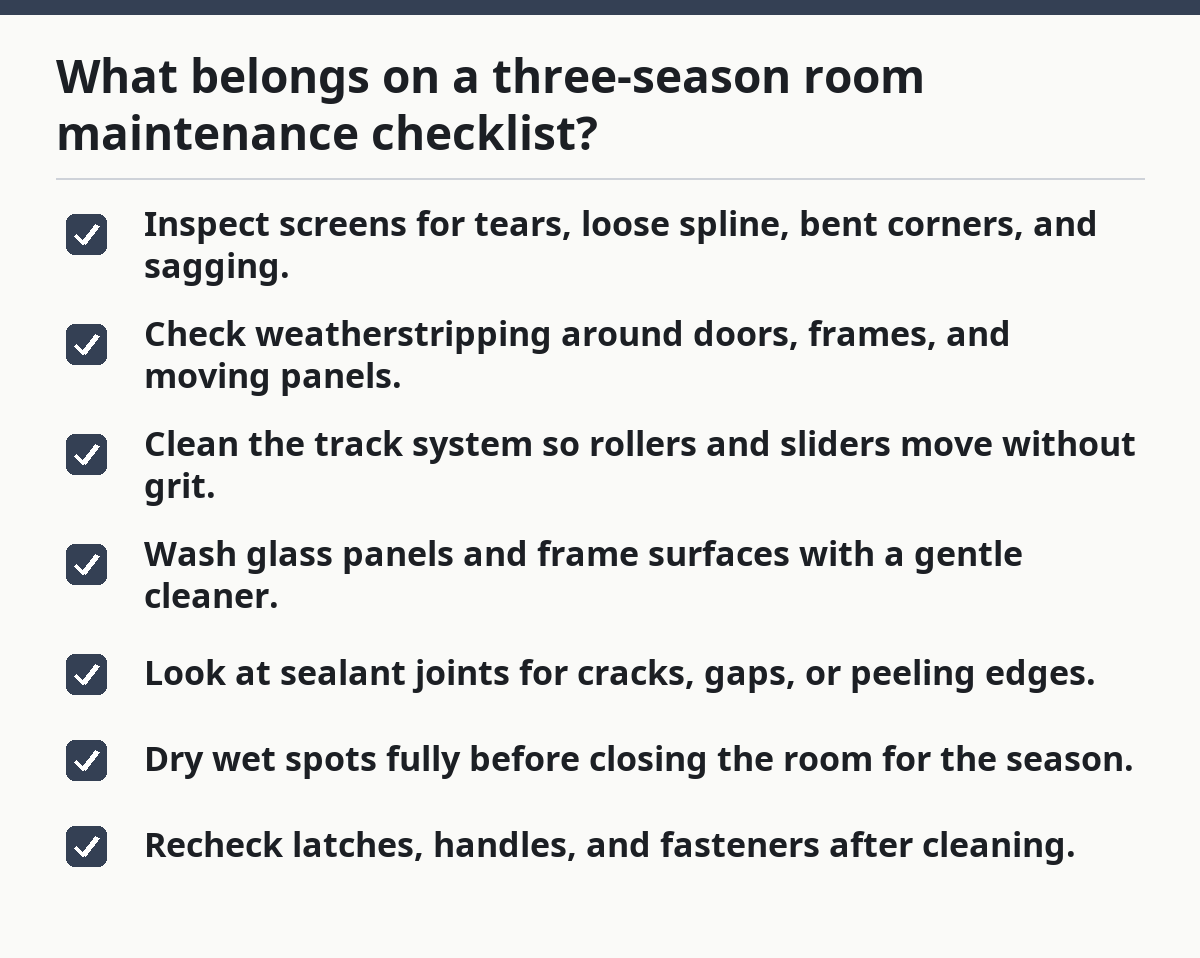
Inspect screens for tears, loose spline, bent corners, and sagging.
-
Check weatherstripping around doors, frames, and moving panels.
-
Clean the track system so rollers and sliders move without grit.
-
Wash glass panels and frame surfaces with a gentle cleaner.
-
Look at sealant joints for cracks, gaps, or peeling edges.
-
Dry wet spots fully before closing the room for the season.
-
Recheck latches, handles, and fasteners after cleaning.
That is the routine most owners can handle on a normal Saturday.
It is also the part a generic article often misses: the room is not just a shell.
The moving parts are what make it usable.
A practical checklist should also separate routine care from damage.
A screen with dust needs cleaning; a screen with torn mesh needs replacement.
A dirty track needs a brush and vacuum; a bent track is not a cleaning issue.
That distinction saves time and keeps a maintenance day from turning into a repair project.
For a broader planning frame, the hub on Designing and using a three-season room can sit above this checklist without repeating the same steps.
How do you maintain a three-season room?
You maintain a three-season room by checking the weak points on a regular cycle and cleaning them before weather and grit wear them down.
A good routine takes about an hour for a small room, longer if the track system is packed with debris or the screens have been neglected for a season.
Start with a quick visual pass in daylight.
Look for loose screen corners, cracked sealant, dry weatherstripping, cloudy glass, standing water, and any track that looks gritty.
Then move from the outside edge of the room inward so dirt does not get pushed into already-clean areas.
Core maintenance steps
-
Open and inspect every panel and screen. Use bright daylight or a flashlight, and check for tears, holes, sagging mesh, and loose frame corners. A small tear is easier to spot now than after wind stretches it.
-
Brush the track system first. Use a small hand brush or vacuum nozzle to lift grit from the channel, corners, and drainage points. Clean tracks help doors and panels slide without scraping.
-
Wash screens gently. Rinse with low-pressure water and a soft brush or cloth. Heavy pressure can stretch mesh or push debris deeper into the frame.
-
Clean glass panels with a non-abrasive method. Use a mild cleaner and a soft cloth, then dry the edges. Clean glass shows streaks less when the frame edges are dry too.
-
Inspect weatherstripping and sealant. Look for flattening, cracks, or places where the material has pulled away. A gap at a door edge can make the whole room feel draftier than expected.
-
Test moving parts. Open and close doors or panels a few times after cleaning. Movement should feel smoother, not rougher, once dirt is out of the way.
-
Finish with a dry check. Leave damp parts open until they are dry to the touch. Trapped moisture is what leads to stains, odor, and early wear.
For seal and weatherstrip guidance, the U.S. Department of Energy recommends air sealing and weatherstripping as standard efficiency steps.
For moisture concerns, the U.S. Environmental Protection Agency says wet materials should be dried quickly to reduce mold risk.
How often should you clean screens and tracks?
You should clean screens and tracks at least at the start of the warm season, again before winter, and any time dirt starts to affect movement or visibility.
A screen that looks fine from far away can still hold dust, pollen, and grime that shorten its life.
The screen schedule is more about condition than a hard calendar.
If the room faces trees, road dust, or frequent wind, screens and tracks need attention more often than a sheltered room.
The same is true after storms that blow debris into the channel or leave grit on the lower frame.
Here is a simple comparison of what each part usually needs:
  Part
  What to check
  Typical maintenance focus
  What happens if you skip it

  Screens
  Tears, sagging, loose spline
  Gentle washing, visual inspection
  More stretching, visible damage, insect entry

  Track system
  Dirt, grit, stuck corners
  Brush, vacuum, wipe dry
  Dragging panels, scratched channels

  Weatherstripping
  Flattening, cracks, gaps
  Look-and-feel check, replace when brittle
  Drafts and water entry

  Sealant
  Splits, peeling, open seams
  Spot inspection at joints
  Moisture creeping into edges

  Glass panels
  Smears, water marks, edge buildup
  Mild cleaning and drying
  Streaking, hard-to-see damage
The mistake most people make is cleaning the visible surfaces and ignoring the working edges.
That costs more later because the damage starts at the contact points.
A spotless panel with a dirty track still feels broken when it sticks halfway open.
This is also where a three-season room differs from a porch.
A porch can stay rough around the edges, but a three-season room has moving parts and seals that need to function, not just look neat.
What should you check before winter?
You should check every opening, seal, and drainage path before winter so cold, moisture, and debris do not sit in the room for months.
Winter prep is the most important part of three-season room maintenance because it protects the room while you are using it less.
The goal is not to make the room warm like a four-season space.
The goal is to close obvious paths for water, snow melt, and wind-driven dirt.
A room that is left half-clean in late fall tends to hold damp debris until spring, which is when stains, corrosion, and odor show up.
Winter prep checklist
-
Remove loose furniture cushions and anything that traps moisture.
-
Clean the track system thoroughly so water does not sit in debris.
-
Inspect sealant around corners, frames, and any fixed panel joints.
-
Check weatherstripping for flattened spots or gaps at doors.
-
Make sure screens are dry before the room is closed up.
-
Look for any place where leaves, needles, or grit collect after rain.
-
Confirm that latches and closures still seat firmly after cleaning.
Do the work on a dry day if possible.
Wet frames make inspection harder, and wet sealant can hide cracks.
If the room has glass panels that show fogging or staining between layers, that is not a maintenance issue to solve with cleaning alone.
The biggest trade-off with winter prep is time versus damage prevention.
It is tempting to do a quick wipe-down and stop there.
That saves 20 minutes and often costs a spring headache when dirt hardens in the track or moisture lingers in the corners.
What should you do in spring when reopening the room?
You should reopen a three-season room by checking for winter damage, cleaning the surfaces, and testing the moving parts before you use the room every day.
Spring is the reset point, and it should be more than a quick dusting.
Start with the same route every year so nothing gets missed.
Open the room, let it air out, and inspect the lower edges first.
Winter weather often leaves the first signs of trouble where water pooled or where wind pushed debris against the base.
A spring reopening routine usually works best in this order:
-
Remove any leftover debris from the floor edge and track system.
-
Check screens for holes that may have grown over winter.
-
Inspect weatherstripping for stiffness or cracking after cold exposure.
-
Wipe down glass panels and frames so you can spot new damage.
-
Examine sealant lines for separation at corners and joints.
-
Operate doors and panels several times to confirm smooth movement.
If a part feels sticky at the start of spring, do not force it.
Dirt in the track may be the cause, but a bent roller or swollen edge can also create drag.
Forcing it can turn a maintenance job into a repair.
Spring is a good time to compare the room to last year’s condition.
If the same corner keeps collecting debris, that is a drainage or fit issue, not a cleaning failure.
If the same seal keeps opening, it is time to treat it as worn out rather than temporary.
What mistakes cost the most over time?
The most expensive mistakes are the ones that look minor: skipping the track, ignoring a cracked seal, and letting moisture sit in the room after cleaning.
Those mistakes are cheap in the moment and annoying later because they affect how the room opens, closes, and dries out.
One common error is using too much water.
A light rinse is usually enough for screens and frames, but soaking the room can push water into joints and under weatherstripping.
Another is using stiff tools on mesh or sealant.
That can tear material that still had useful life left.
Here are the mistakes worth avoiding:
-
Using high pressure on screens. It can stretch mesh and loosen edges.
-
Leaving dirt in the track system. It wears moving parts and makes panels harder to open.
-
Ignoring brittle weatherstripping. Small gaps become drafts and moisture paths.
-
Treating cracked sealant as cosmetic. Open seams can let water in, so consult a professional if you are not sure how extensive the damage is.
-
Closing the room while damp. That traps moisture where it can stain and smell.
The limit of routine maintenance is simple: it cannot fix damaged parts.
A torn screen, a split seal, or a bent track is past basic upkeep.
That is the point where maintenance stops and repair begins.
A checklist helps you catch the line between the two early.
When should you stop and get help?
You should stop and get help when a frame is bent, a panel will not seat, a seal is failing across a long run, or moisture keeps coming back after cleaning.
That is no longer routine maintenance; it is a sign that the room has a deeper problem.
Do not keep forcing a stuck panel or stuffing more sealant into a joint that keeps opening.
The short-term fix can hide the cause and make later work harder.
A room that sheds water, shifts in the frame, or shows repeated movement problems is outside basic checklist care.
This is the right place for caution because the room is built from parts that have to fit together.
Once the fit is off, cleaning only buys time.
It does not restore the original function.
If you are seeing visible damage, repeated opening at the same seal, or cracks that keep returning, DOE guidance on air sealing and EPA moisture guidance both point toward fixing the source rather than masking the symptom.
FAQ
How do you maintain a three-season room?
You maintain a three-season room by inspecting screens, cleaning the track system, checking weatherstripping, washing glass panels, and watching sealant joints for wear.
The routine is seasonal: once before warm weather, once before winter, and any time wind or rain leaves debris behind.
Small problems are easiest to handle before they become movement or moisture issues.
How often should three-season room screens be cleaned?
Three-season room screens should be cleaned at least twice a year, with extra cleaning after heavy pollen, wind, or storms.
A room near trees, dirt paths, or open fields may need more frequent attention because debris builds up faster on mesh and in the lower frame.
Cleaning is also a chance to spot tears before they spread.
What should you do before winter with a three-season room?
Before winter, you should clean the room, dry it fully, clear the track system, and inspect weatherstripping and sealant for gaps.
Winter prep is about reducing moisture and closing obvious openings, not turning the room into a heated space.
If a panel or seal is already damaged, that needs attention before cold weather settles in.
Drafted with AI; not yet reviewed by a person.