
Last updated: November 18, 2026
A three-season room warranty is only as good as its coverage limits, installation clause, and maintenance rules. The three-season room warranty language on the page matters more than the marketing flyer, because the manufacturer, the installer, and the installation agreement can each carry a different promise.
Key takeaways
- A warranty on a three-season room is not one promise; it can split between the maker of the parts and the company that installs them.
- Coverage often turns on specific wording like “material defect,” “workmanship,” and “proper maintenance.”
- Installation mistakes can void coverage even when the parts themselves are fine.
- Transferability matters if the house may be sold later, because some warranties stay with the original buyer only.
- A strong warranty is clear about what it covers, what it excludes, and what proof the owner must keep.
What does a three-season room warranty actually cover?
A three-season room warranty usually covers defects in the product, not every problem that shows up after the room is built. That means the promise may apply to material defects, failed seals, broken fasteners, warped panels, or other problems tied to the parts themselves, but not to damage caused by weather, misuse, or poor upkeep.
This is where the words get sharp. “Material defect” points to a flaw in the product as made or supplied. “Workmanship” points to the way the room was installed. A manufacturer may cover one and the installer may cover the other, or the same company may write separate rules for each.
A beginner often expects the warranty to work like insurance. It does not. If a panel clouded because it was scratched during cleaning with the wrong pad, the warranty may exclude it. If a latch fails because the frame was installed out of square, the installer may be the one responsible. The paperwork has to say which party owns which risk.
Therefore, the terms also tend to name parts and time periods in different ways. A frame may carry one term, glass or screening another, and labor a shorter term than the materials. Even without a specific year count printed here, the structure matters: parts and labor are rarely covered on the same timeline. Read each line as its own promise.
A practical habit is to treat the three-season room warranty like a checklist, not a brochure. Look for the exact product name, the installation date trigger, and the claim steps. For general consumer language on warranty rights, the FTC explains how written warranties work on Warranties and the Magnuson-Moss rules are summarized by the FTC at Magnuson-Moss Warranty Act. For a plain-English review of consumer warranty complaints and comparisons, see Consumer Reports on warranties.
Who is responsible: manufacturer or installer?
The manufacturer is usually responsible for defects in the parts, while the installer is usually responsible for how the room was put together. That split sounds simple, but it causes the most confusion when a problem shows up six months after installation and both sides point at each other.
A manufacturer warranty can cover the frame, panels, seals, or other supplied components if they arrive with a defect. An installer warranty can cover labor, alignment, fastening, flashing, and the fit between the room and the house. The installation agreement should spell out whether the installer is acting as a contractor, a dealer, or a middle layer between buyer and manufacturer.
Because of that split, the installation agreement matters as much as the warranty sheet. If the contract says the installer must follow the manufacturer’s written instructions, then a skipped step can shift responsibility. If it says the owner must sign off after completion, the clock on some claims may start then. If it says warranty claims must go through the dealer, the buyer may need to contact one party first even when another party made the part.
A common mistake is assuming the seller of the room and the installer are the same legal promise. They may not be. One company may sell the kit, a second may assemble it, and a third may service claims. If the names on the invoice, warranty card, and installation agreement do not match, that is a sign to slow down and ask who handles each part of the claim.
The simplest test is to ask three questions before money changes hands: who covers the parts, who covers labor, and who handles the claim. If any answer is vague, the three-season room warranty is weaker than it looks.
How do installation clauses change the warranty?
Installation clauses can narrow a warranty fast because they tie coverage to exact methods, materials, and conditions. If the contract says the room must be installed by an authorized installer, with specified fasteners, sealants, or anchors, then a small change in method can become a denied claim.
This is not a minor detail. A warranty may be written to protect the maker from failures caused by bad assembly, while also protecting the buyer from defects in the product itself. That means the clause can help or hurt depending on who did what. A roof panel leak may be covered if the panel was flawed, but not if the leak came from an unapproved flashing method.
A good way to read this section of the paperwork is to trace the verbs. Words like “must,” “only,” “as instructed,” and “authorized” are where coverage often tightens. If the contract says the installer must follow the manufacturer’s manual, then the manual becomes part of the warranty terms even if it was not attached to the sales page. If it says the owner must not modify the room, adding trim, vents, or storage hooks may become risky.
Here is a simple order for checking installation-related terms:
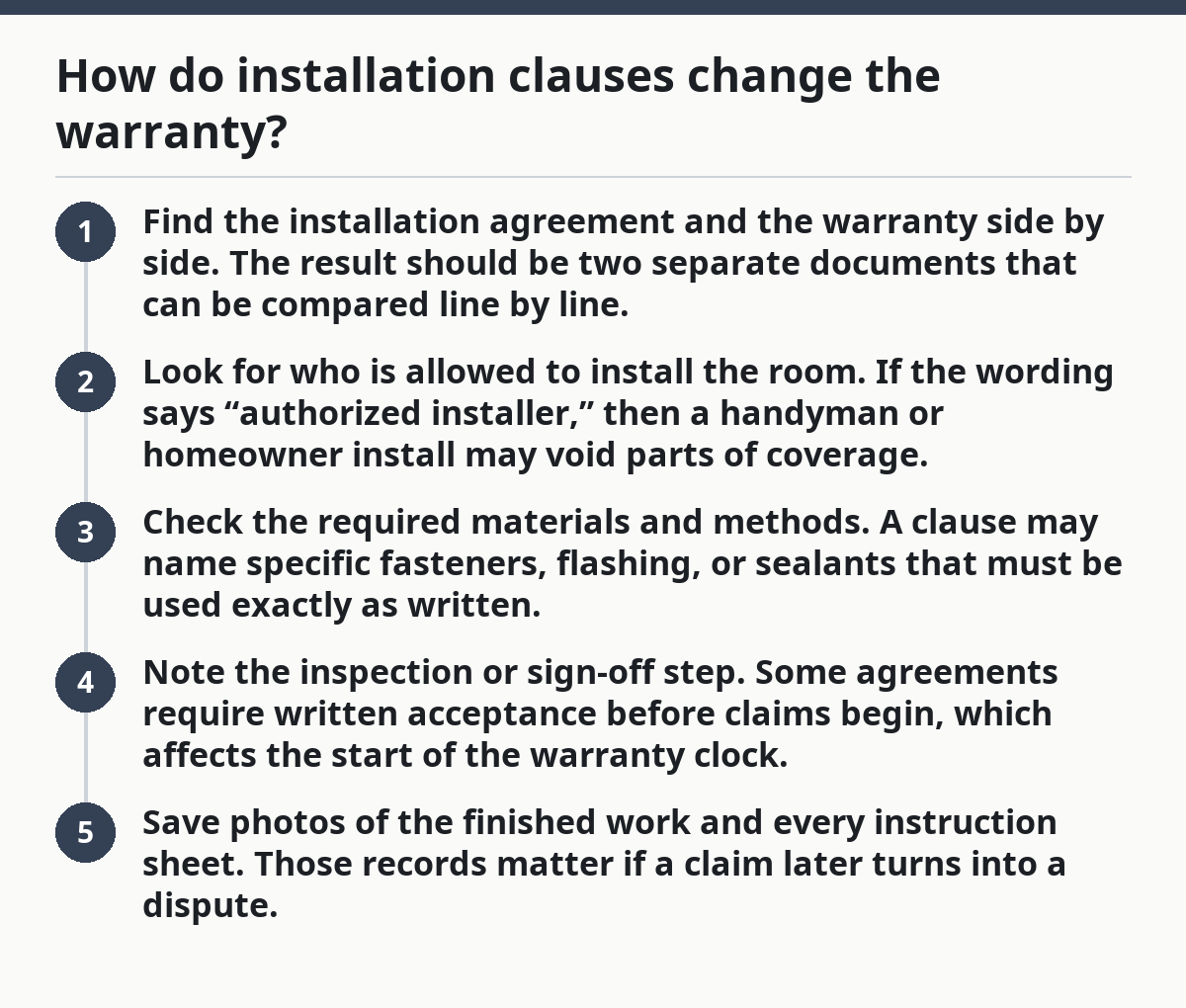
- Find the installation agreement and the warranty side by side. The result should be two separate documents that can be compared line by line.
- Look for who is allowed to install the room. If the wording says “authorized installer,” then a handyman or homeowner install may void parts of coverage.
- Check the required materials and methods. A clause may name specific fasteners, flashing, or sealants that must be used exactly as written.
- Note the inspection or sign-off step. Some agreements require written acceptance before claims begin, which affects the start of the warranty clock.
- Save photos of the finished work and every instruction sheet. Those records matter if a claim later turns into a dispute.
The hard truth is that installation clauses are one of the most common places where expectations and coverage split. This is not the page for guessing. If the room will be installed by anyone other than the named installer, the buyer should assume the warranty could change.
What maintenance requirements should you expect?
Maintenance requirements usually ask the owner to clean, inspect, and protect the room on a set schedule, because neglect can void coverage. A warranty often expects basic care, not perfect care, but the line between the two is written into the terms.
Many three-season room warranties require the owner to keep drainage paths clear, avoid harsh cleaners, and prevent standing water or trapped debris. Some terms also require prompt reporting of visible damage. If a crack grows for months without notice, the company may argue the problem got worse because no one acted sooner.
Because drainage and reporting are often tied together, this is where buyers get caught. A warranty may look generous until it says coverage depends on regular maintenance “as recommended by the manufacturer.” That phrase can point to a separate care guide. If the care guide says to inspect seals every 6 months or clean with a soft cloth only, those instructions become part of the claim test.
Maintenance clauses also matter because they can move the burden of proof onto the owner. If the company says the room was not maintained, the owner may need photos, receipts, or dated notes to show basic care. That is one reason to keep the manual in the same folder as the purchase papers, not in a drawer at the back of the house.
The main trade-off is plain: stricter maintenance rules can protect the product and lower claim risk for the maker, but they also create more ways for a claim to be denied. A buyer who wants less paperwork should look for simpler care terms before signing.
Is the warranty transferable if the house is sold?
Sometimes, but not always, and the transfer rule can affect resale. A transferable warranty may stay with the home for a later buyer, while a nontransferable warranty ends with the original purchaser.
This matters because many people think a warranty follows the product by default. It does not. The contract may require notice within a certain window after the sale, a transfer fee, or written proof of the new owner’s name. Some warranties transfer only once. Others transfer only the remaining term, not the original full term. The paperwork has to say which version applies.
Transferability also affects the kind of records that should be kept. If the room may be sold in a few years, the owner should save the invoice, installation agreement, warranty certificate, and any claim approvals. A future buyer may ask for them during the sale, and missing documents can make a transferable warranty hard to use.
The limitation here is simple: a transferable warranty is useful, but only if the transfer steps are followed exactly. A buyer who ignores the notice deadline or fails to register the transfer may lose the benefit even when the room itself is fine.
This is one of the rare warranty terms that can help both sides. The original buyer gets a stronger resale story, and the next owner gets some protection. Still, transfer language should be read closely because it can be one of the shortest sections in the contract and one of the easiest to miss.
Which warranty terms should make you pause?
A short warranty with vague exclusions should make a buyer pause, especially if it avoids naming the exact parts covered. If the terms say “normal wear,” “acts of nature,” or “improper use” without examples, the room may have less real coverage than the brochure suggests.
The biggest warning signs are not dramatic. They are dull and easy to skip: no clear definition of defect, no distinction between parts and labor, no claim process, no maintenance list, and no mention of transfer. A warranty can look long and still be weak if the important words are hidden in exclusions.
Another red flag is any term that leaves all judgment with the seller. If the paper says the company decides whether damage was caused by installation, weather, or misuse, the buyer is relying on that company to interpret its own contract. That does not make the warranty useless, but it does make a claim harder if a dispute arises.
A safer approach is to compare at least two documents: the warranty sheet and the installation agreement. If both use the same names for the room, the same claim steps, and the same exclusions, the buyer has a clearer picture. If one document says one thing and the other says something else, the mismatch deserves a written answer before the purchase moves ahead.
The honest downside of careful reading is time. The upside is avoiding a warranty that sounds broad but covers very little. That is the point where a buyer should slow down, not speed up.
How do you read the warranty before signing?
You read a three-season room warranty by checking the covered parts, the exclusion list, the installation rules, the maintenance duties, and the transfer terms in that order. That order keeps the most useful details from getting buried under sales language.
Start with the named product. If the warranty does not clearly identify the room model or system, the rest of the document is harder to use. Then find the section on defects and see whether it covers only materials, only workmanship, or both. After that, scan for exclusions and any clause that ties coverage to installation by an approved contractor.
Next, look for the claim process. Some warranties require written notice, photos, serial numbers, or proof of purchase. Others require the owner to contact the installer first. If the claim steps are missing, the promise is weaker because no one can tell how to use it.
A short, practical read can be done in under 15 minutes:
- Circle the exact product name and model if one is listed.
- Mark every sentence that starts with “except,” “unless,” or “provided that.”
- Find the page that names the installer’s duties and compare it with the warranty page.
- Check for maintenance language that mentions cleaning, inspection, or care intervals.
- Look for transfer language and any deadline tied to resale.
- Keep the signed installation agreement, the warranty, and any care sheet together.
The point is not to become a lawyer. The point is to know whether the warranty promises a real repair path or just a nice-looking sheet of paper.
What does a three-season room warranty usually cover?
A three-season room warranty usually covers defects in the materials or workmanship named in the document, not every problem that appears after installation. The exact coverage depends on the manufacturer, the installer, and the installation agreement. Parts, labor, and finish details may each have different rules, so the written terms matter more than the sales summary.
Does installation affect the warranty on a three-season room?
Yes, installation can affect the warranty on a three-season room a great deal. If the room is installed outside the manufacturer’s instructions, or by someone not approved in the contract, some or all coverage may be denied. The installation agreement often sets the rules that decide whether a later claim succeeds.
What voids a three-season room warranty?
A three-season room warranty can be voided by unauthorized installation, unapproved changes, poor maintenance, or damage caused by misuse. Missing claim steps can also cause trouble if the contract requires notice, photos, or proof of purchase. A practical move is to keep the warranty, installation agreement, and care instructions together from day one.
Drafted with AI; not yet reviewed by a person.