Last updated: November 17, 2026
A small three-season room works best when every piece earns its place: keep the center open, use folding or slim furniture, and push storage to the walls. That approach gives you a room that still feels light, usable, and easy to cross even when the footprint is tight.
Key takeaways
- Keep the middle of the room free so the space reads larger and feels easier to move through.
- Pick furniture that folds, stacks, tucks, or stores something inside it.
- Use the walls for storage before you add more floor pieces.
- A room can hold more than one purpose if each zone stays visually simple.
- The wrong move in a small three-season room is crowding it with deep seating and heavy, fixed furniture.
How do you plan a small three-season room?
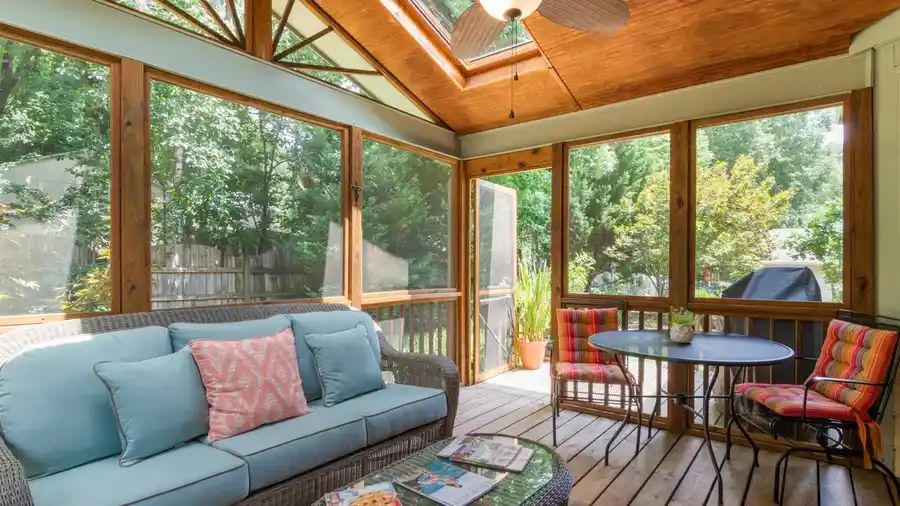
A small three-season room starts with a clear circulation path, not with a shopping list. If the room is narrow, the first job is to decide where people will walk, where a chair can sit, and which wall can carry storage without blocking the view.
Start by measuring the room in 2 directions and marking the door swing, window lines, and the widest clear path you want to keep open. In a small room, a straight path from door to seating area is usually better than trying to route traffic around a bulky table.
Use this basic layout process:
- Measure the room’s length and width, then sketch it on paper or a phone note. The result is a simple map that shows what space you actually have.
- Mark the main walkway from the door to the far side. A clear run through the room keeps the layout from feeling trapped.
- Place one anchor piece first, such as a bench storage unit or a slim console table, against the wall with the least traffic.
- Add one seating piece, like a bistro set or folding chair, instead of filling the room with a full furniture group.
- Leave the center open unless a table truly needs to live there. That open zone makes the room easier to use and easier to reset.
- Test the layout by imagining a tray, a plant, and a person moving through at the same time. If that feels tight, remove one item.
This plan follows the same logic used in accessibility guidance from the U.S. Access Board and the CDC’s fall-prevention advice: clear routes are easier to use than cluttered ones. For reference, the U.S. Access Board publishes its standards and guides at access-board.gov and the CDC home-safety page is at cdc.gov/falls/prevention/home.html. You do not need to copy those rules into a home exactly, but the idea is sound: open paths help a small room work.
A common mistake is putting a table in the middle before the seating is set. That costs you floor space twice, because the table blocks movement and forces the chairs outward. If the room is very small, anchor the room to a wall first and let the center stay light.
What furniture fits best in a small three-season room?
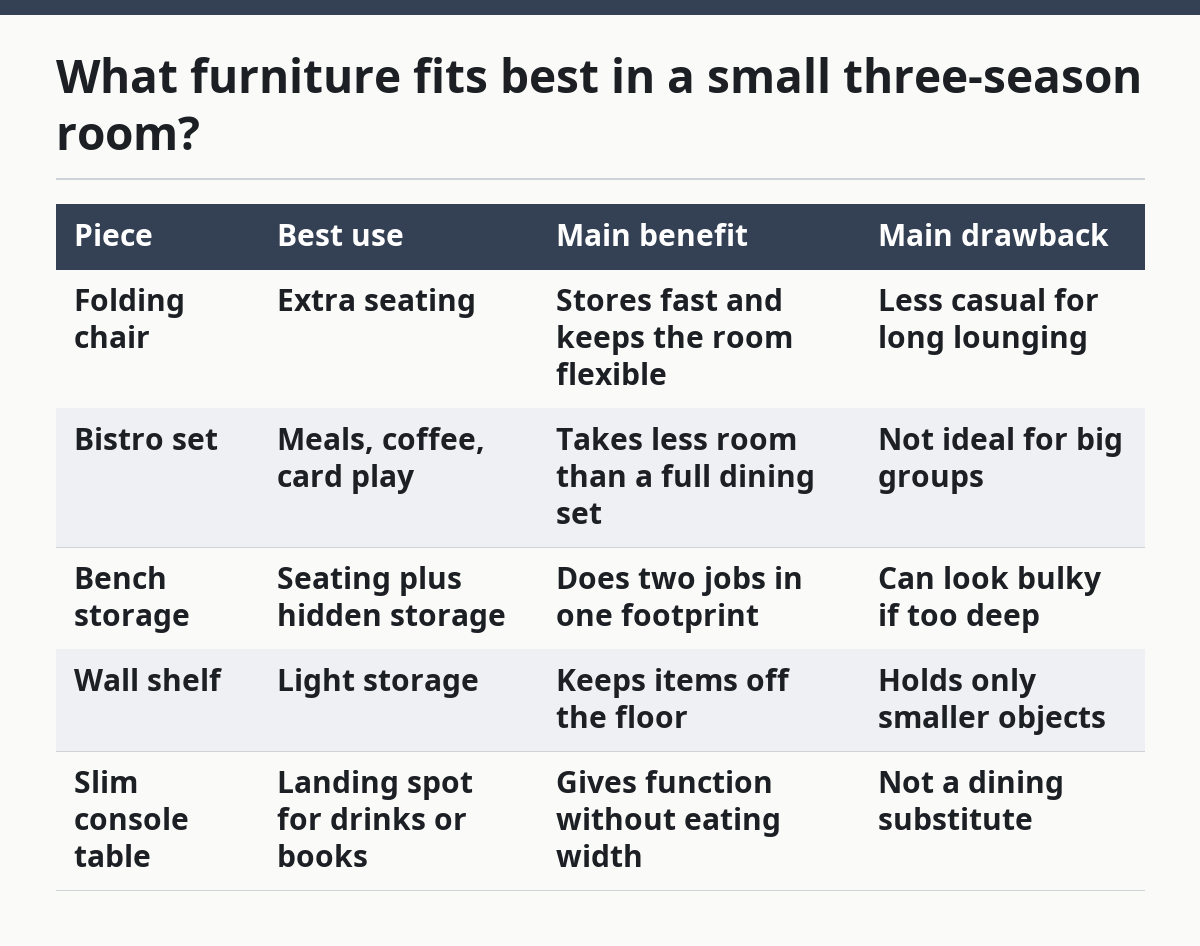
The best furniture for a small three-season room is low-profile, movable, and easy to hide or fold away. A bistro set, folding chair, bench storage, wall shelf, and slim console table fit this job better than deep sofas or oversized sectionals.
Use this simple comparison to choose pieces by function:
| Piece | Best use | Main benefit | Main drawback |
|---|---|---|---|
| Folding chair | Extra seating | Stores fast and keeps the room flexible | Less casual for long lounging |
| Bistro set | Meals, coffee, card play | Takes less room than a full dining set | Not ideal for big groups |
| Bench storage | Seating plus hidden storage | Does two jobs in one footprint | Can look bulky if too deep |
| Wall shelf | Light storage | Keeps items off the floor | Holds only smaller objects |
| Slim console table | Landing spot for drinks or books | Gives function without eating width | Not a dining substitute |
The best choice for many small rooms is one anchor piece and one light secondary piece, not a full set. A bench storage unit can replace both a chair and a small cabinet. A slim console table can handle keys, a lamp, or a tray without forcing you into a wide table shape.
Do not choose furniture only by length; depth matters more in a small room. A 20-inch-deep piece can feel manageable where a 30-inch-deep piece makes the room feel pinched. That difference is what turns a workable room into a cramped one.
A plain bistro set is often the strongest choice when the room is used for coffee, reading, or a quick meal. It gives a small room a purpose without making it feel packed. If you want lounging first and dining second, a bench storage unit plus folding chair usually gives more flexibility.
How do you make the room feel open?
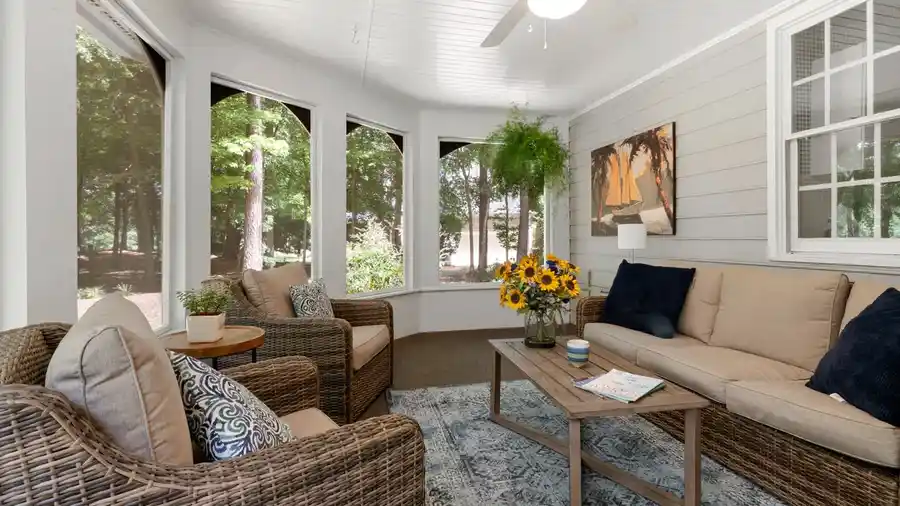
A small three-season room feels open when the eye can travel across it without stopping at heavy shapes. Light visual lines matter as much as furniture size, and that means keeping the lower half of the room as open as possible.
Choose pieces with legs instead of solid bases when you can. Raised furniture lets you see more floor, which makes the room look larger even when the footprint has not changed. A wall shelf does the same job in the upper half of the room by moving storage off the floor.
Three moves help the room look wider without adding clutter:
- Keep the tallest piece on the shortest wall when the room is narrow.
- Use one slim console table instead of two small tables that create extra visual noise.
- Leave a 2-part view line open: floor first, wall second, furniture last.
Mirror tricks and high-contrast styling can help in other rooms, but this page is about layout, not décor. In a three-season room, the safer move is simple: fewer objects, fewer heights, cleaner edges. That approach works because it supports the window line instead of fighting it.
Avoid the mistake of lining every wall with furniture. That can make the room feel like a storage closet with windows. Give at least one wall a clear stretch, even if it is only a few feet, so the room has somewhere to breathe.
What are the best space-saving layouts?
The best space-saving layouts for small three-season rooms are wall-hugging, corner-based, and multi-use. A room with one main purpose is easiest to arrange, but a small room often needs two jobs, so the layout has to protect the walkway first and the secondary use second.
A corner layout works well when you want the room to function as a reading spot or a coffee nook. Put the bistro set near one corner, place a wall shelf above it, and keep the opposite wall open. That leaves the center free and gives the room one clear destination.
A wall-to-wall bench layout works better when you need storage and seating in the same footprint. Put a bench storage unit along the longest wall and use one folding chair only when needed. That arrangement can be calmer than a mix of several small chairs, because the room reads as one clean line.
A multi-use layout is the right answer when the room must handle more than one task. For example, a slim console table can serve as a landing spot for drinks during the day and as a work surface for a laptop in the evening. The key is to keep each use in the same zone so the room does not become a puzzle of overlapping furniture.
The wrong layout for a small room is a full center cluster. That approach steals the very thing the room needs most: open floor. If the room feels awkward, start by removing the middle piece before you touch the walls.
How do you use vertical storage without crowding the room?
Vertical storage is the fastest way to add function without taking more floor space. A wall shelf, a narrow hanger rail, or a high ledge can hold the items a small three-season room needs while keeping the lower half clear.
Put the lightest, least-used items up high and keep the everyday items at reachable height. A wall shelf works best for books, trays, or baskets that do not need deep space. If a shelf projects too far, it turns into a knee hazard or a visual block.
Use these rules to keep vertical storage useful:
- Keep shelf depth slim so it does not dominate the wall.
- Stop stacking items to the ceiling unless the room is used for long-term storage.
- Group objects into one or two clean runs instead of spreading them across every wall.
- Leave window lines open when possible so the room still feels connected to the outside.
Bench storage also counts as vertical thinking in a small room because it stores inside the footprint you already need for seating. That is often better than adding a separate cabinet. A slim console table can also carry storage baskets underneath if the legs leave enough room.
Do not treat every wall as storage space. A room with too many wall pieces starts to feel busy fast, and the windows lose their job as the main visual feature. In a small three-season room, the best vertical storage is the kind you barely notice.
What should you avoid in a small three-season room?
A small three-season room should avoid heavy, fixed, and deep furniture that blocks movement or eats the view. The most common mistake is buying pieces for a larger room and trying to shrink the plan later.
The biggest problems are predictable:
- A deep sofa can swallow the room and leave no easy walking path.
- A big dining table can make the room feel like it has only one job.
- Too many accent pieces create clutter faster than they add comfort.
- Oversized storage pieces can block windows and darken the room.
The cost of these mistakes is not just visual clutter. The room becomes harder to clean, harder to change, and less likely to get used often. A small room should invite quick use, not ask for rearranging every time someone wants to sit down.
The better choice is to start with one strong function and build around it. If the room is for coffee and reading, use a bistro set or folding chair. If the room needs storage, use bench storage or a slim console table before you add anything decorative. If the room needs flexibility, choose furniture that can be moved in under a minute.
That trade-off matters. A small three-season room can feel calm and practical, but it will rarely feel spacious if every square foot is filled. The safest rule is simple: if a piece does not help the room work, it does not belong there.
Can a small three-season room still be comfortable?
Yes, a small three-season room can still be comfortable if the layout leaves room to sit, move, and set things down. Comfort in a room this size comes from fit, not from volume.
Think in layers. One seat, one place to set a drink, and one storage option can be enough. A bistro set can handle mealtime, a folding chair can handle extra guests, and a bench storage unit can hide the items that would otherwise sit on the floor.
Comfort also depends on how often the room changes use. If it is a morning coffee room, a slim console table may be all you need. If it shifts from reading space to card table to overflow seating, the best setup is one that can reset in a few minutes.
A small room is not wrong because it is small. It becomes unpleasant when it is overfilled or forced into a single heavy layout. Keep the path clear, choose pieces that do more than one job, and let the room stay visually light.
How do you make a small three-season room feel bigger?
A small three-season room feels bigger when the floor stays visible and the furniture stays low, slim, and simple. That means using fewer large pieces, keeping the center open, and using wall shelf space before adding more floor storage.
The quickest wins are a bench storage unit instead of a bulky cabinet, a folding chair instead of a fixed extra seat, and a slim console table instead of a wide table. A clear sight line through the room does more for the space than adding another object.
What furniture fits in a small three-season room?
Furniture that folds, tucks, or stores is the best fit for a small three-season room. A bistro set, folding chair, bench storage, wall shelf, and slim console table all work because they keep the room useful without taking over the floor.
The wrong fit is usually a deep, fixed piece that was meant for a larger room. If a piece blocks the walkway or makes the center feel boxed in, it is too large for the job.
Can a small three-season room still be comfortable?
Yes, if comfort comes from smart use rather than from size. A small three-season room can feel comfortable with one good seat, one surface, and a layout that does not force people to squeeze past furniture.
The room becomes more comfortable when it is easy to enter, easy to sit in, and easy to reset. That is why simple pieces often work better than a crowded mix of bigger ones.
Drafted with AI; not yet reviewed by a person.