Last updated: November 16, 2026
Quick answer: a three-season room lighting plan usually works best with 2 or 3 layers of light—ambient, task, and accent—plus dimming. Three-season room lighting has to handle glare by day and low light at dusk, so the right mix makes the space useful after sunset without turning it into a harsh sunroom. Start with one ceiling fixture, then add a table lamp, wall sconce, or string lights where the room needs warmth or focus.
Key takeaways
- A three-season room usually needs more than one light source, not one bright fixture in the middle.
- Dimmers matter because the room has two jobs: bright enough for evening use, soft enough for relaxed seating.
- Outdoor-rated fixtures make sense in spots that may face damp air or more dust from open screens.
- String lights add mood, but they do not replace task lighting for reading or dining.
- A layered setup often uses 2 or 3 lights, rather than a single “fix everything” lamp.
What makes three-season room lighting different?
Three-season room lighting is different because the room gets uneven daylight, more glare, and more weather exposure than a regular interior room. A room with screens or lots of glass can feel bright at noon and dim at 8 p.m., so the lighting has to work across both conditions.
That is why a plain ceiling light often disappoints. It can leave corners dark, reflect off glass, and make the room feel flat once the sun drops. A better plan uses at least 2 lighting layers: one general light, one local light for reading or dining, and sometimes a third accent source for mood.
The room’s edge matters as much as the center. Light near a wall, a sofa, or a table helps the space feel finished, while light placed only overhead can make the floor look dark. In a room with a 3-season feel, the goal is useful light, not museum-level brightness.
A ceiling fixture still belongs in many rooms, but it should be only part of the answer. Pairing it with a table lamp or wall sconce can give you more control than relying on one oversized fixture. For a broader planning frame, this page fits under the larger guide to designing and using a three-season room.
Which light layers work best?
The best three-season room lighting ideas usually use ambient light, task lighting, and a little accent light, in that order. Ambient light fills the room, task lighting helps a person read or eat, and accent light softens the edges so the space feels inviting after dark.
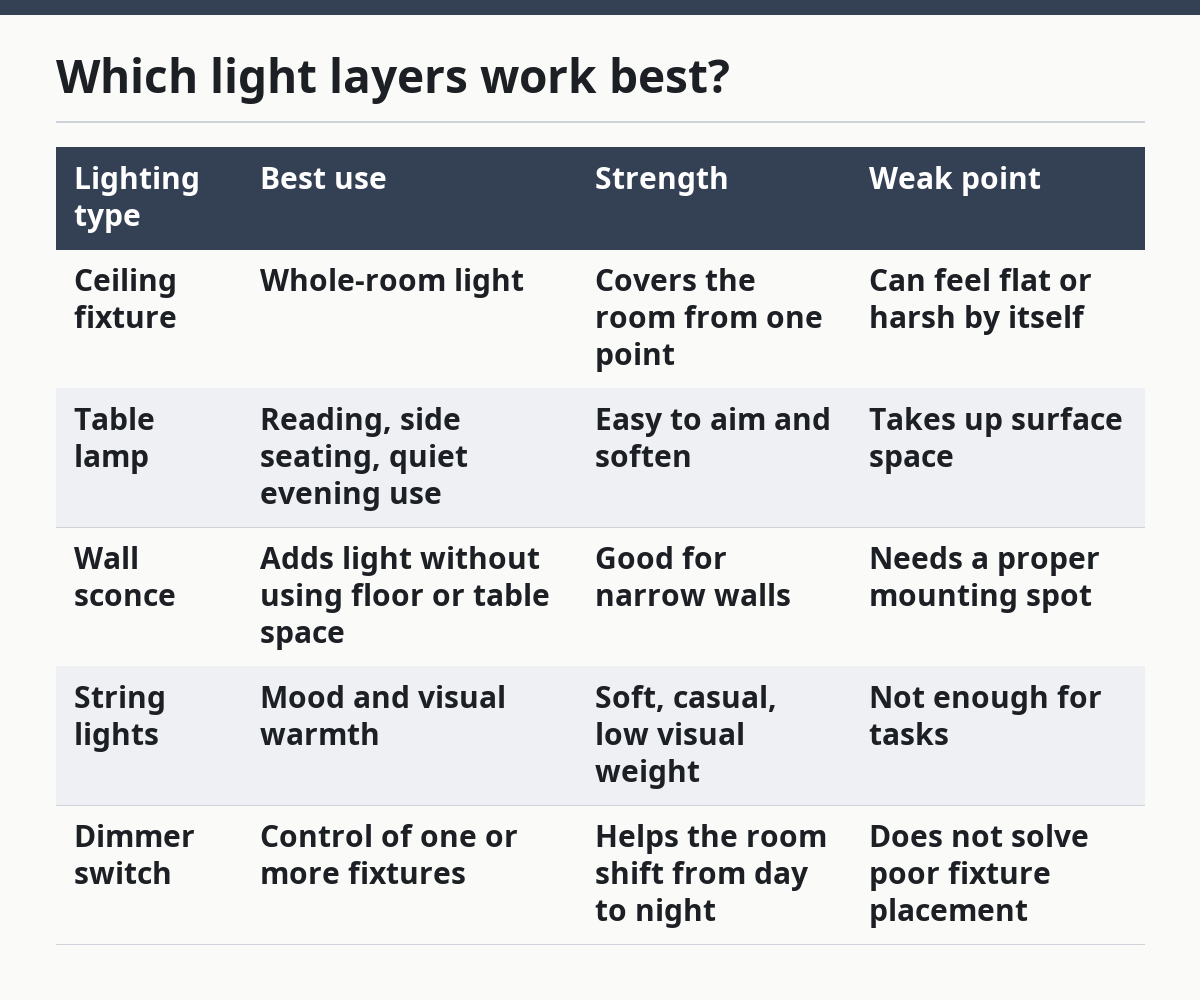
A simple table makes the trade-offs easier to see:
| Lighting type | Best use | Strength | Weak point |
|---|---|---|---|
| Ceiling fixture | Whole-room light | Covers the room from one point | Can feel flat or harsh by itself |
| Table lamp | Reading, side seating, quiet evening use | Easy to aim and soften | Takes up surface space |
| Wall sconce | Adds light without using floor or table space | Good for narrow walls | Needs a proper mounting spot |
| String lights | Mood and visual warmth | Soft, casual, low visual weight | Not enough for tasks |
| Dimmer switch | Control of one or more fixtures | Helps the room shift from day to night | Does not solve poor fixture placement |
A room with a 10-by-12-foot feel does not need every layer at once, but it usually needs at least 2 types of light to avoid glare and shadow. If the room is used for cards, reading, or late dinners, task lighting matters more than decorative glow.
This is also where restraint helps. Too many small lights can make the room busy, while too few can make it feel like an afterthought. A single ceiling fixture plus one table lamp often beats five weak lights scattered at random.
What ceiling fixture should I start with?
A ceiling fixture should give the room its base light without shouting for attention. For many three-season room lighting ideas, that means a flush mount, semi-flush mount, or a simple pendant, depending on ceiling height and how much open space sits below it.
A flush mount works well when the ceiling is low or the room is compact. A semi-flush mount gives a little more presence and often spreads light more gently. A pendant can look right over a table, but it is less useful if the room has several seating zones and no clear center point.
The light source matters too. A warm bulb around 2700K or 3000K usually feels more relaxed than a cool, blue-white light. In a room that already gets a lot of daylight, a warmer tone keeps the space from feeling cold in the evening.
If the room is exposed to damp air, choose an outdoor-rated fixture or one listed for damp locations where appropriate. That does not mean every fixture in the room must be industrial. It means the fixture should match the room’s exposure, especially near doors, screens, or spots that collect humidity.
Avoid a fixture that throws a hard beam straight down and leaves the corners dark. That setup can make the center bright and everything else dull, which is exactly the wrong look for a room meant to feel open. For fixture basics, the U.S. Department of Energy’s lighting guide is a useful reference.
How do I use lamps and sconces without clutter?
Table lamps and wall sconces work best when they solve a specific job, not when they are added just to fill space. A table lamp is ideal near a chair or sofa where a person reads for 30 minutes or longer. A wall sconce helps when the room is short on surface space or when the layout needs light at the perimeter.
A good rule is to place light at the level where people use the room. A lamp next to a chair gives direct light for pages, cards, or a laptop. A sconce on a long wall can keep the room from feeling like a tunnel after sunset.
Spacing matters more than style here. If a lamp sits too far from the seat, it glows but does not help. If a sconce is mounted where it reflects into eyes, it becomes a nuisance. The point is to light the task, not the wall.
This is where a dimmer switch earns its keep. One fixture on a dimmer can do more work than 2 fixed lights with the wrong output. For evening use, lowering the level by a small amount often softens glare from glass and screens without making the room dark.
A common mistake is using decorative lamps as the only light source. That can leave the room uneven and tiring to use. Another mistake is matching every shade and base too closely, which can make the room feel stiff instead of lived-in. The better move is to use 1 or 2 lamps with a clear purpose and let the rest of the room stay visually quiet.
Are string lights enough for evening use?
String lights are enough for mood, but they are not enough for real room use. They can make a three-season room feel warm at night, yet they do very little for reading, dining, or cleaning up after dark.
That does not make them a bad choice. It just puts them in the right category. A strand of string lights can soften a ceiling line, outline a beam, or add a gentle glow around the perimeter. In a room used mainly for conversation, that may be exactly the right amount of light.
The catch is glare and overuse. Bare bulbs that hang too low can become the brightest thing in the room and pull the eye away from everything else. If the strand is close to seating, keep it out of view enough to avoid a harsh line of light.
They work best when they are paired with another source. A ceiling fixture on low or a table lamp next to a seat gives the room function; string lights give it warmth. That mix is often better than a single decorative strand stretched across the room and called done.
Use string lights with restraint if the room already has strong daylight during the day. Too much decorative light in a small room can look busy at night and cluttered during the day. One strand is usually enough to make the point.
What should I choose for glare and weather exposure?
For glare and weather exposure, choose fixtures that can handle the room’s conditions and soften the light source. In a three-season room, the problem is often not too little light, but light placed where glass, screens, or pale surfaces bounce it back into view.
Outdoor-rated fixtures are a sensible starting point near exposed edges, doors, or places that may see more moisture and dust. They are designed for tougher conditions than a typical dry interior fixture, which makes them a better fit for semi-outdoor space. If the room stays dry and enclosed most of the time, indoor fixtures may still work in protected spots, but it is best to check the location carefully and consult a qualified electrician or lighting professional if you are unsure. The National Electrical Code overview is a helpful place to start.
Glare control is just as important as durability. A shade, frosted globe, or indirect source usually feels easier on the eyes than a bare bulb. If light reflects sharply off a window or screen, move the source, soften the bulb, or add a shade before adding more wattage.
A dimmer switch helps here because it gives the room a second mode. Bright enough for tasks, soft enough for a low-key evening. That flexibility matters more in a room that shifts from sunlit afternoon to darker night use in the same day.
The weak choice is a bright, uncovered fixture aimed straight at the center of the room. It looks fine on paper and feels wrong in use. A better setup usually means lower output, more shade, and one or two supporting lights placed where people actually sit.
What is a simple lighting plan I can copy?
A simple lighting plan for a three-season room is one ceiling fixture, one task light, and one soft accent source, all on separate control where possible. That 3-part setup covers most of the ways people use the room without making it feel busy.
Start with the ceiling fixture as the base. Then add a table lamp near the primary seat or reading spot. Finish with string lights or a wall sconce if the room still feels flat in the evening. If there is only one seating area, keep the layout close to that zone instead of spreading lights across every wall.
Here is a practical order to follow:
- Pick the room’s main job, such as reading, dining, or general sitting, so the lighting matches the use.
- Choose one ceiling fixture that covers the whole room without harsh glare, often a flush mount or semi-flush mount.
- Add one task light near the seat or table, usually a table lamp or wall sconce.
- Put the dimmer on the light you use most often, so the room can shift from day use to evening use.
- Add string lights only if the room still feels plain after the main layers are in place.
This plan works because it solves the biggest lighting problem first: uneven use across daylight and evening. It also keeps the room flexible. If the room is used only a few nights a week, the plan still feels calm. If it is used daily, it avoids the strain of one overworked fixture.
It is not the right plan for a room that needs true all-night work light or a full electrical rework. It is for people who want a three-season room to feel usable, comfortable, and easy on the eyes without turning it into a formal interior room.
What should I avoid?
Avoid one bright center fixture, too many decorative bulbs, and light sources that fight the room’s glass and screens. Those choices are common because they seem simple, but they usually create the same problem: a room that is bright in the wrong places and dim where people sit.
A few mistakes show up again and again. One is choosing a fixture by style alone and ignoring how the room is used. That costs comfort, because a pretty fixture can still throw bad light. Another is treating string lights like the main plan. That costs function, because the room may look nice but still be hard to read in.
Another mistake is mixing very cool and very warm light with no plan. That can make the room feel patchy, especially after sunset. A room with one consistent color tone, such as warm white, usually feels calmer and less fussy.
The last mistake is ignoring the room’s exposure. If a fixture is in a more open or damp spot, it should be chosen with that in mind. Picking the wrong type can shorten the life of the fixture and make the room feel unfinished.
A good three-season room does not need a lot of light sources. It needs the right few, placed for the way the room is actually used.
What kind of lights should go in a three-season room?
A three-season room should have a ceiling fixture, at least one task light, and a dimmer if possible. That mix covers daytime glare, evening use, and the shift between the two without making the room feel overlit. Outdoor-rated fixtures also make sense in more exposed spots, especially where damp air or dust is more likely.
Can you use outdoor lights in a three-season room?
Yes, you can use outdoor lights in a three-season room when the room’s exposure calls for it. That choice is especially useful near doors, screens, or damp edges, where a tougher fixture makes more sense than a standard dry-location light. The fixture still needs to suit the room’s layout and should not create harsh glare. For planning, the Consumer Product Safety Commission also has general electrical and fixture safety guidance.
How bright should a three-season room be?
A three-season room should be bright enough to read, talk, or eat without strain, but not so bright that it feels stark. The best level often comes from 2 or 3 light layers with dimming, rather than one very bright source. Warm light around 2700K or 3000K usually feels easier on the eyes in the evening.
Drafted with AI; not yet reviewed by a person.







One thought on “Three-season room lighting ideas”